by A. Gwynn Henderson and David Pollack
The original mouth of the Scioto River, in what is now southern Ohio, is far from Oklahoma. So far, perhaps, it has been forgotten. But important events in Shawnee history—in the mid-1700s and thousands of years earlier—took place there.
Two painted panels on Portsmouth, Ohio’s floodwall highlight its importance. One shows the many geometric earthworks and mound that once spanned the Ohio River there, but that is a story for another time. The other mural (pg. 14) illustrates the most important, and largest, Shawnee town of the mid-eighteenth century.
In 1751, Chillicothe stood on both sides of the Ohio River at the mouth of the Scioto. It is more widely known by its English name, the lower Shawnee Town. It was home to the Shawnee people and their tribal allies, a diplomatic center, and a trading hub. No traces of the town are visible today, but archaeological evidence in Kentucky testifies to its presence. Once you know its history, this place comes alive. It is not hard to imagine a bustling village of over 1,200 people deep in Indian Country.
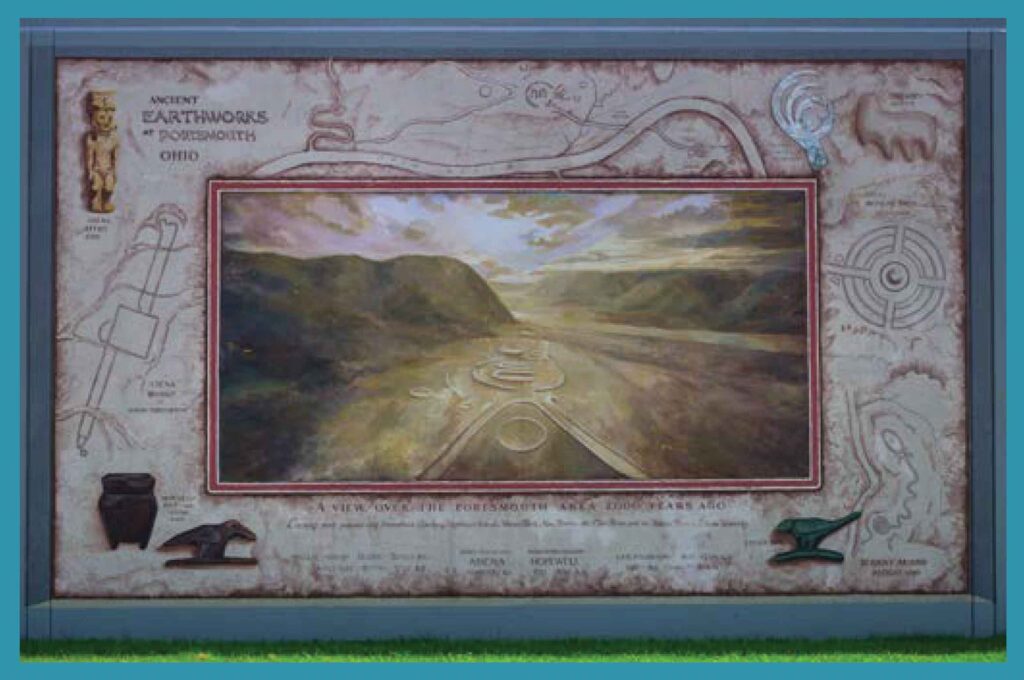
Photo courtesy Portsmouth Murals Inc. The Portsmouth Group of mounds and earthworks, looking eastward across the Ohio River floodplain as the sun rises over the Kentucky river bluffs. People of the Hopewell period built these structures for religious, celestial, and communal reasons, beginning sometime around 0-200 CE. Mid-nineteenth-century maps of the Portsmouth Group and Serpent Mound—interspersed with drawings of Native-made pipes, a footed ceramic jar, and a mica hand cut-out—form the border of this mural by Robert Dafford (b. 1951).
A REVITALIZED SHAWNEE CENTER
Shawnee people had left the middle Ohio Valley in the late 1600s. They were reeling from the devastating impacts of the smallpox pandemic and fearful of Haudenosaunee raids. In the 1730s, they returned to the river valley of their ancestors. Rich in natural resources, it was a good place to return to. There was fertile soil, mixed hardwood forests, flat grassy plains, and cane breaks. Clear streams and freshwater and salt springs were everywhere.
Descendants of Shawnee groups who had settled on the Susquehanna and Delaware rivers established the lower Shawnee Town. Their relatives had occupied the spot just 200 years earlier. Most had lived among other Native peoples. All had experienced the impacts of Europeans on their way of life.
In the 1740s and 1750s, other Shawnees joined the settlement. By then, members of most, if not all, of the five Shawnee divisions lived in the town. Other tribal people also called the lower Shawnee Town home. They included Seneca, Delaware, and missionized Indians from near Montreal.
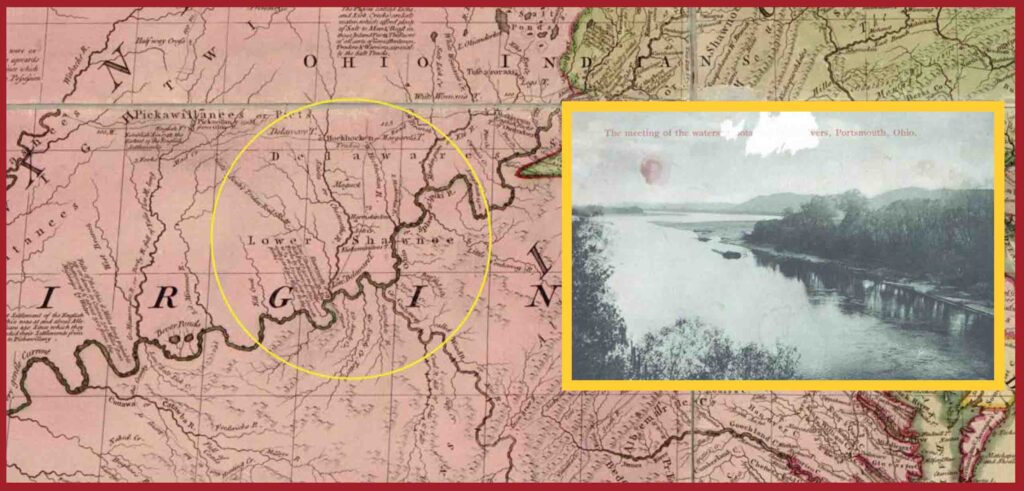
This section of John Mitchell’s 1755 map shows both parts of the lower Shawnee Town along the Ohio River: “Shawnoah” on the north side; “Low. Town” on the south side. A north-south trail extends through the town, connecting the community to Native settlements north on the Scioto River. Two different symbols – a mound with or without a flag – reflect the differences in size and function of the town’s two parts. At that time, the community’s council house stood in the northern part, as did English trading houses. Right: A postcard, circa 1907-1914, shows the meeting of the Scioto and Ohio Rivers, the former site of the town.
View more of the John Mitchell’s 1755 map on the Library of Congress’s website.
A TRADING CENTER
The town was perfectly situated to be a major English trading center. Water routes and overland trails, including the Warriors Path, extended through the settlement. Residents, as well as Native people from surrounding towns, brought furs and deerskins to the town’s trading houses. In exchange, they received items like linen, ribbons, and stockings. Durable goods included guns and gunflints, copper kettles, knives, and glass beads. Archaeologists have recovered fragments of these objects in trash pits.
VILLAGE LIFE
Daily life within the community probably followed the rhythms of centuries past. Women tended fields of corn, beans, squash, tobacco, and sunflowers. They collected wild plants like hickory nuts, grapes, and sumac for food or medicine. Men hunted mainly deer, bear, elk, and turkey using bows and arrows as well as the guns they had received in trade.
A LARGE COMMUNITY
In 1751, the lower Shawnee Town was at least twice as large as earlier Shawnee villages and bigger than most Indian settlements in the region at that time. But despite the presence of many tribal groups, the town’s location was distinctly Shawnee.
One hundred houses were scattered across the floodplain on the north side of the Ohio River. Forty houses stood on the narrow floodplain and higher terraces south of it. These houses were built of a wooden pole framework, covered with either bark, mats, or skins. They measured 30 feet by 60 feet and had rounded corners.
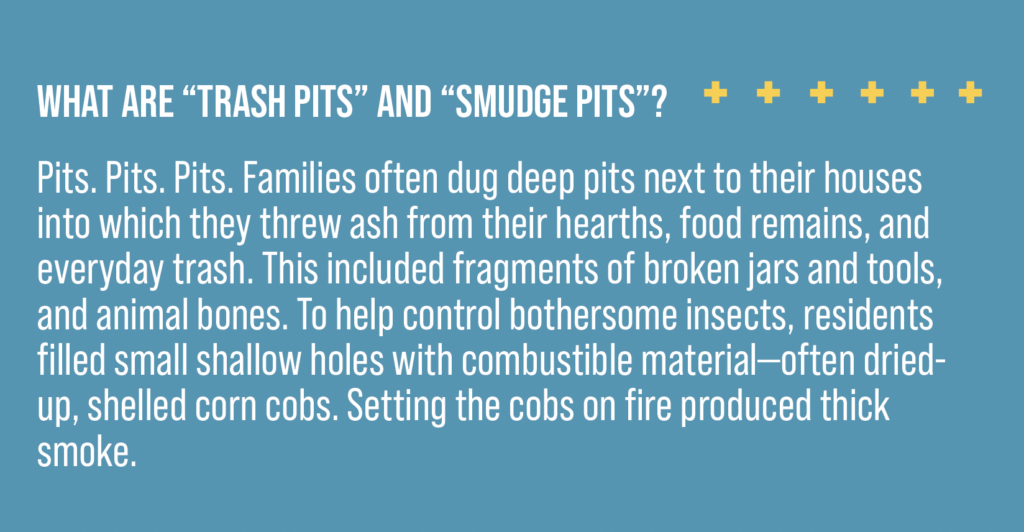
Extended families lived in each house. From the archaeological record, we know some families used small river pebbles to chink poles firmly in place. Smudge pits, cemeteries, and trash pits were near the houses. As was common for the time, some families built their houses of squared logs covered with bark or clapboard. A few even had chimneys.
In the early 1750s, the lower Shawnee Town was the center of Shawnee tribal politics. It was the home of Shawnee leaders Misemeathaquatha (Big Hominy) and Newcommer. At times, other notable Shawnee leaders, like Tomenibuck and Lawachcamicky, also may have stayed there. These men would have hosted town-wide meetings in the 90-foot-long rectangular council house. The settlement was an international diplomatic center, too. Members of the Cherokee, Miami, and Delaware nations came to town to meet with the Shawnee. Europeans on mid-level diplomatic missions from the colonies also visited the town.
With the outbreak of the French and Indian War in 1754, the lower Shawnee Town’s location became a handicap, exposing residents to the risk of English attacks. So, sometime between April and November 1758, the Shawnee people moved their village northward. In the 1760s, Native people and English diplomats sometimes met at the old town’s location. Traces of it were still visible on the Kentucky side of the Ohio in 1773. In the late 1930s, archaeologists rediscovered the lower Shawnee Town as part of the Works Progress Administration’s sprawling archaeology program.
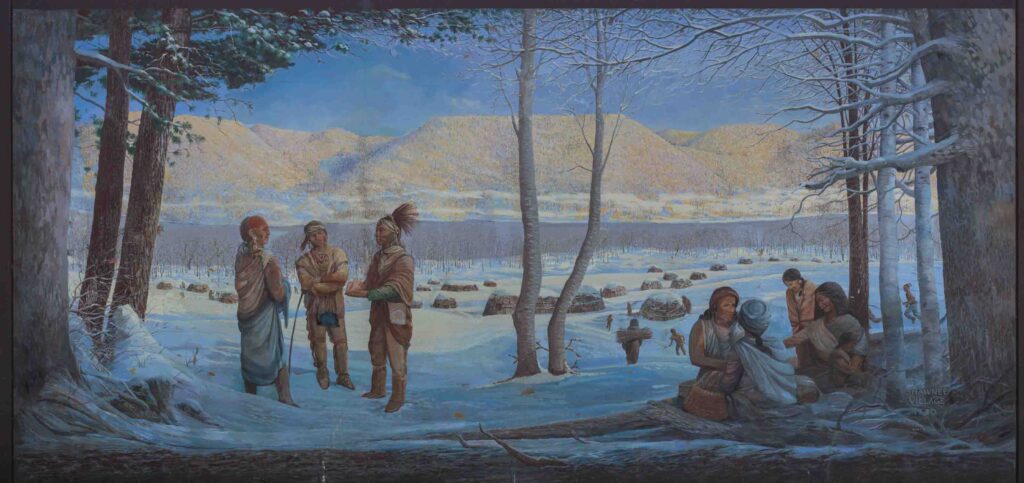
Here, Robert Dafford’s floodwall mural shows the mid-eighteenth-century Shawnee village of Chillicothe (also known by the English name “Shannoah” and the French name (“Sonnioto”) in winter circa 1740. The view is looking across the Ohio River at the narrow Kentucky floodplain and its high river bluffs. The town’s bark-covered council house appears in the center. Smaller, bark-covered residences are scattered upstream and downstream of the council house. Photo courtesy Portsmouth Murals Inc.
To learn even more online, visit Discover Kentucky Archaeology at archaeology.ky.gov, or go straight to the page on Lower Shawnee Town.
ABOUT THE AUTHORS
A. Gwynn Henderson (Education Director) and David Pollack (Director) work for the Kentucky Archaeological Survey, Department of Society, Culture, Crime & Justice Studies at Western Kentucky University. They received their PhDs in Anthropology from the University of Kentucky in 1998. Their involvement in Fort Ancient/ Shawnee archaeological research began in the early 1980s, when they analyzed and reported on archaeological materials recovered from the lower Shawnee Town. One of their ongoing research projects focuses on the lifeways of ancient Native farming cultures of the middle Ohio Valley.