Aug 31, 2026
RECYCLING SPOTLIGHT: BATTERIES
BATTERIES: Why batteries shouldn’t end up in landfills. Key Reasons to Avoid Disposing Batteries in Landfills:

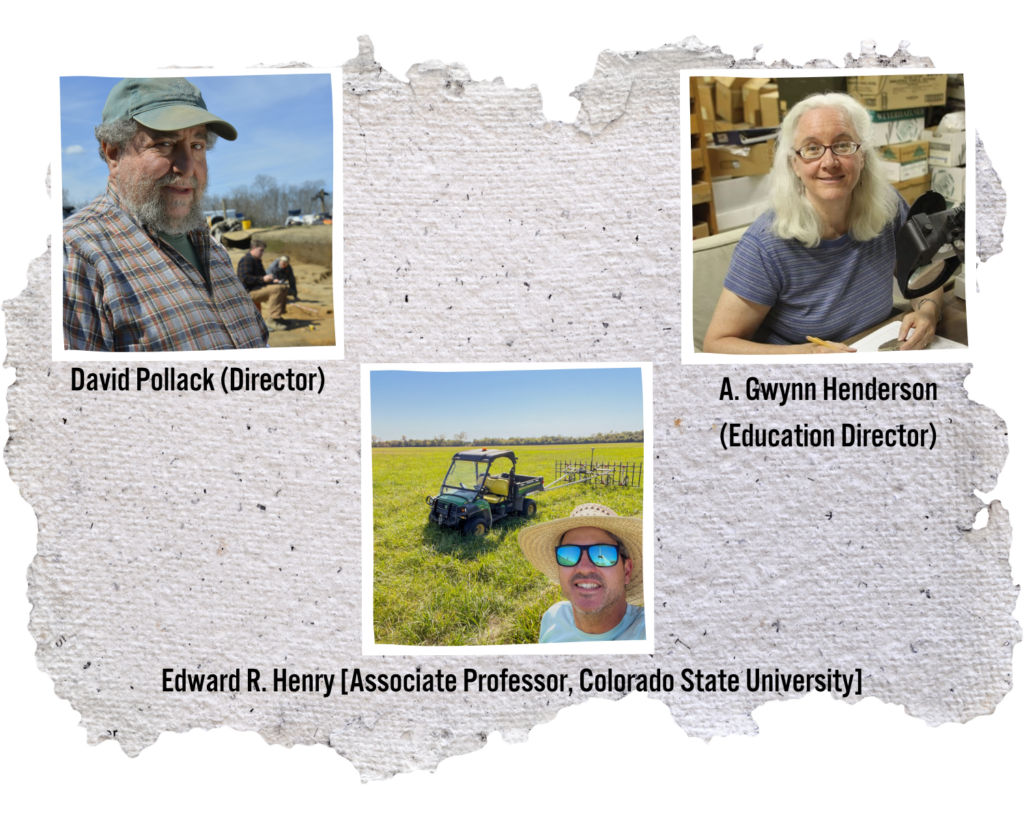
By David Pollack, A. Gwynn Henderson, and Edward R. Henry
A people’s relationship to their homeland is dynamic. How they alter the landscape reflects their sense of place, their social relationships, and their connections to their ancestors.
This is as true now as it was in the past.
The North Elkhorn Creek Earthworks
Around 500 BCE, near North Elkhorn Creek in central Kentucky, ancestors of the sawanwah (Shawnee) began to alter the landscape to express their spirituality in very visible ways. They built large oval enclosures. Later, they constructed smaller, circular enclosures. For over 2,000 years, Native people came together in this ritual precinct to mark the movement of the sun, moon, and stars. To celebrate the changing seasons. To strengthen social ties with one another. Traces of these earthworks are still visible today.
The Peter Enclosure: Phase One
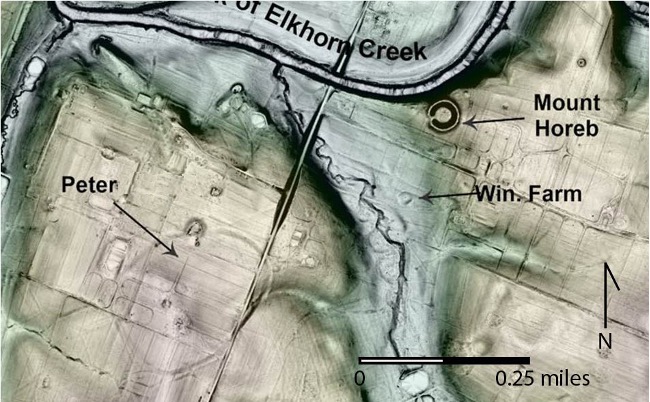
| A LiDAR (Light Detection and Ranging) map showing the three North Elkhorn Creek enclosures. LiDAR is a remote sensing technology that uses pulsed lasers to produce precise, highly accurate topographic maps. |
The first landscape change was the construction of the large Peter Enclosure. People used, maintained, and modified it for over 300 years. First, they built an oval arrangement of over 3,000 wooden posts. It surrounded more than 25 acres of a broad ridgetop. Each post averaged eight inches in diameter. While builders may have left open the spaces between the posts, it is more likely that they wove smaller saplings between them to create a screen. Worshipers used this enclosure for a century.
Think of the effort it took to build it! To cut down each tree with a stone ax. Shape it with a stone adze. Bring each prepared post to its place: a hole dug with only a wooden digging stick. All this work took time, and it needed someone to organize people to make such an ambitious project a reality.
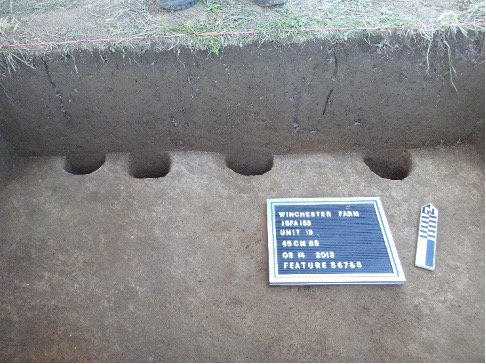
| Investigations revealed dark soil stains, shown here partially excavated, where wooden posts once stood. Archaeologists estimate that 110 posts made up Winchester Farm’s post-screen enclosure |
And how many trees would it have taken to maintain this large structure for 100 years? Let’s do the math. If workers replaced each post every 20 years (because of deterioration due to rot or insects or weathering), then the ancestors of the Shawnee would have replaced each post at least five times. Three thousand posts replaced five times totals 15,000 posts. Undoubtedly, as the years passed, builders would have traveled farther and farther to find suitable trees. And in the process, they would have changed the surrounding landscape.
The Peter Enclosure: Phase Two
Around 400 BCE, the people who used the Peter Enclosure changed how they worshiped there. Did a lack of suitable nearby trees force this change? Did their rituals or beliefs change? We do not know. But whatever the cause, they removed the wooden post screen. And in its place, they dug a 6-foot-deep by 9-foot-wide ditch enclosing an area of similar size. They used this new earthwork-enclosed space for at least 200 years.
Digging the ditch meant moving a lot of earth and stone. Workers had few tools: wooden digging sticks and baskets made from rivercane or other material. They used the digging sticks to loosen the soil, and they moved the soil in baskets. And the energy to remove more than 6,000 tons of earth? That came from human muscle.
Where did the soil go? Recent excavations show that these ancient builders piled the soil up on the ground on either side of the ditch, forming embankments. Archaeologists estimate that each embankment originally stood about three feet tall. Erosion and plowing have worn down the embankments, so they are now hard to see.
Mount Horeb and Winchester Farm Enclosures
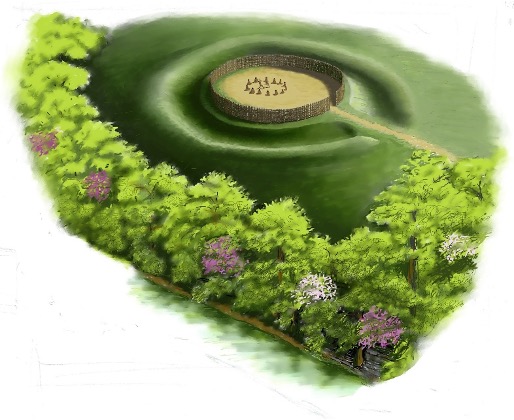
| Artist’s reconstruction of the Mount Horeb Enclosure. |
Around 200 BCE, the descendants of the people who used the Peter Enclosure built new, and much smaller, enclosures. Mount Horeb and Winchester Farm measured less than 100 feet in diameter, and covered only 0.3 and 0.1 acres, respectively. Their size implies that smaller groups of people used these sacred spaces.
These small earthworks share a few elements with the larger Peter Enclosure. Posts surrounded the central area at both Mount Horeb and Winchester Farm. And, as at Peter, following the construction of a wooden post screen enclosure, worshipers dug a deep ditch and created embankments. But unlike at Peter, worshipers at Mount Horeb left a section of the circle undug, creating a formal causeway.
Linking the Generations
Regardless of size, the woven wooden screens and earthen embankment walls of each North Elkhorn Creek enclosure formed symbolic boundaries, setting ritual spaces apart from the regular world. It is likely that only the people directly involved in the ceremonies could enter these sacred spaces.
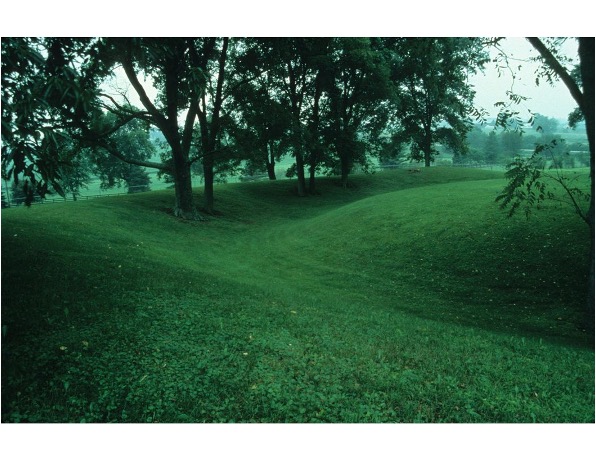
| View of Mount Horeb looking west, showing (from left to right) the embankment, ditch, central area, and an edge of the causeway. It is owned and protected by the University of Kentucky. Upon request, Shawnee tribal citizens can visit it. |
The people of central Kentucky stopped building enclosures at the North Elkhorn Creek ritual precinct about 1500 years ago. We do not know why. Their landmarks endured, however, silent witnesses to ancient beliefs; physical records of their makers’ commitment.
Over the centuries, descendants of the people who built the enclosures continued to visit and maintain their ancestors’ earthworks. A testament to the power of place, these ancient ritual spaces connect generations of Native people across millennia.
To Learn More
For more information about Kentucky’s earthen enclosures and the power of place, download the Early-Middle Woodland period poster and booklet for Kentucky Archaeology Month 2024 at https://kyopa.org/kentucky-archaeology-month/
Read more about the Mount Horeb Earthworks here: https://archaeology.ky.gov/Find-a-Site/Pages/Mt.-Horeb.aspx
Authors’ Bios
A. Gwynn Henderson [Education Director] and David Pollack [Director] work for the Kentucky Archaeological Survey, Department of Society, Culture, Crime & Justice Studies at Western Kentucky University. They received their PhDs in Anthropology from the University of Kentucky in 1998. Edward R. Henry [Associate Professor, Colorado State University] received his PhD in Anthropology from Washington University in St. Louis in 2018. He studies the ways ancient people in Eastern North America created deep historical ties to places across their landscapes. His research focuses on earthen enclosures.
BATTERIES: Why batteries shouldn’t end up in landfills. Key Reasons to Avoid Disposing Batteries in Landfills:
The Shawnee Tribe is accepting public comments from tribal citizens about the Low Income Home Energy Program (LIHEAP) in preparation for next fiscal year, which begins October 1. All Shawnee households residing in the state of Oklahoma are encouraged to provide comments. Submit comments here through Monday, August 27, 2026. The LIHEAP program also still has funding […]
The Shawnee Tribe is proud to celebrate the accomplishments of Marina Staubus, whose artwork Whispers in the Wind earned First Place in the Painting category at the 2026 55th Annual Trail of Tears Art Show in Tahlequah, Oklahoma. Marina, a Shawnee Tribe citizen, continues a family tradition of service and dedication to the Tribe as the daughter of Mike Staubus, […]
A traditional bow-making workshop recently brought together Shawnee youth and cultural instructors to share knowledge, skills, and values that have been passed down through generations. The opportunity began when a request was made to teach Shawnee relatives the traditional craft of bow making. Having previously shared these skills with Muscogee participants, the instructors were honored […]
The Hidden Cost of Four Everyday Products When we buy a product, we usually see only the price on the shelf. What we don’t see is the environmental cost of making it. For example, it takes about 2,700 liters (713 gallons) of water to produce a single cotton T-shirt—about the same amount one person drinks […]
Mark McDowell, Treasurer and Keni Hood, Business Council Seat 7 have filed seeking re-election to their respective offices. The filing period for candidates has passed, with no additional candidates declaring their intention to run for office. Therefore, in accordance with Title 6, Sec. 6.20.080 of the Shawnee Election Act, both unopposed candidates are hereby deemed […]
YOUR CAN COULD BE BACK ON THE SHELF IN JUST 60 DAYS! You enjoy your beverage and recycle your aluminum can. Recycling trucks collect the cans and take them to a facility to be sorted. The cans are cleaned and shredded into small pieces. The aluminum pieces are melted down and rolled into large sheets. […]
The Shawnee Tribe’s Environmental Department recently hosted a hands-on learning experience focused on water systems, runoff, and watershed education in the Miami community. During the event, students participated in the installation of a rain barrel system while learning how rainfall moves through local watersheds and contributes to flooding.