
Wild Turkey Bones Share Their Stories

By A. Gwynn Henderson, David Pollack, and Bruce L. Manzano

Ancient wild turkey bones recovered from archaeological sites in the Middle Ohio River Valley hold centuries-old stories. Like Native stories and songs passed down through many generations, these bones whisper of Indigenous hunting strategies and of how Native hunters changed those strategies when circumstances called for it. These stories rely on the marked physical differences in male and female wild turkeys. 

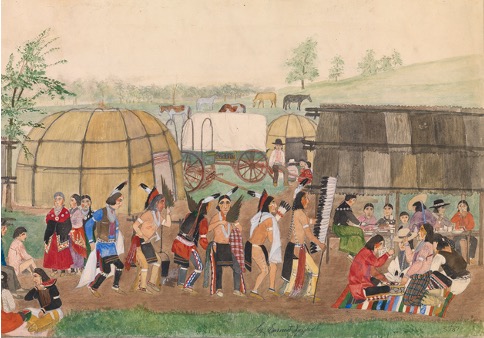
Three dancers carry turkey wings in Kickapoo Feather Dance by Earnest L. Spybuck/Mahthela (Absentee Shawnee), a watercolor drawing he completed in 1910.

Image credit: National Museum of the American Indian, Washington, D.C.

Wild Turkey Bone Facts

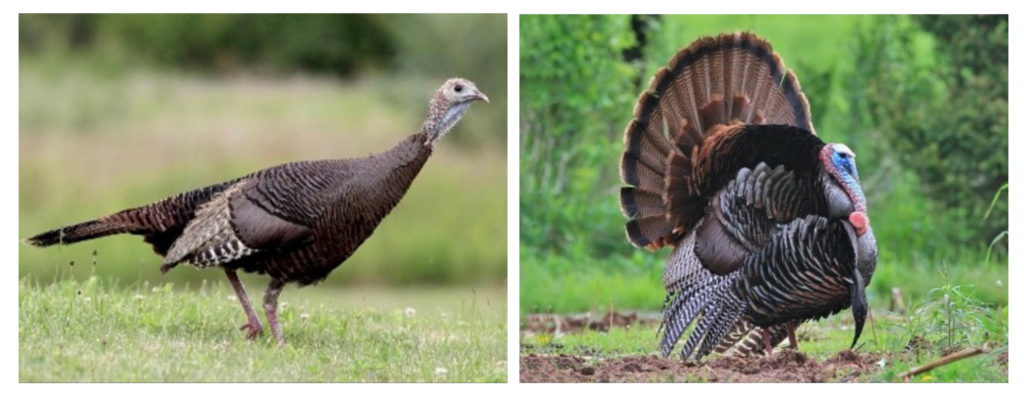
Take a look at a gobbler or Tom (male turkey) and hen (female turkey) side by side. 

Wild turkey hen (left) and a gobbler or Tom (right).


Image Credit: 
Cornell Lab – All About Birds: Wild Turkey
Hen: Charlotte Farrell 
Tom: Petra DeBruine

https://www.allaboutbirds.org/guide/Wild_Turkey/photo-gallery/311368611

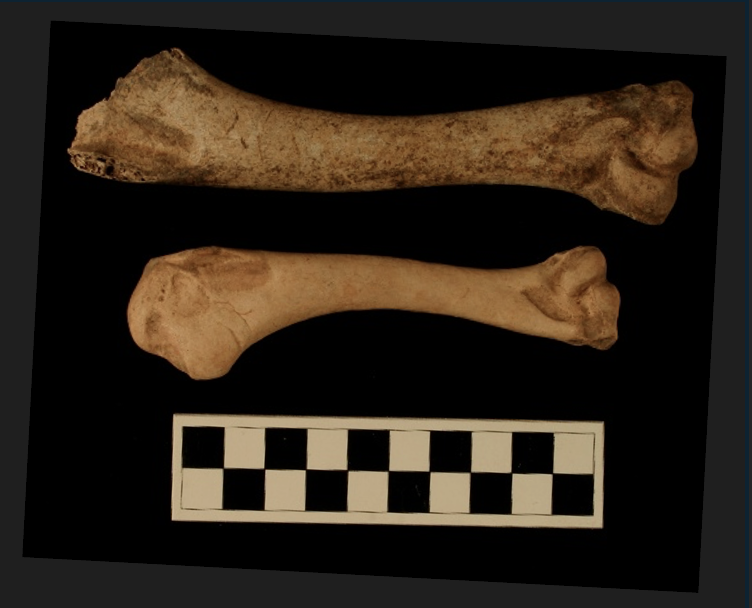
The main difference is easy to see: males are much larger than females. It shows up clearly in the size (the length and width) of wild turkey long bones (legs and wings). Thank goodness for that. Because without this difference, it would be hard for zooarchaeologists (scientists who specialize in the study of ancient animal bones) to distinguish between the remains of male and female wild turkeys recovered from archaeological sites. 

Wild turkey upper wing bones (humeri) show what zooarchaeologists and wildlife biologists call pronounced sexual dimorphism: the sharp difference in size between male and female wild turkeys: male, right humerus (top) and female, left humerus (bottom).
 
Image credit: Kentucky Archaeological Survey.
Scale is 10 centimeters.

But wild turkey bones hold other clues, too. Gobblers have a bone spur on each of their lower legs; hens do not. In contrast, estrogen-dependent medullary (med-juh-ler-ee) bone – granular calcium deposits found in the marrow cavity of hen long bones – develops during a hen’s egg-laying cycle. It provides the calcium needed for eggshell formation. Gobblers do not lay eggs, so of course, they do not produce medullary bone. 

What does all this have to do with ancient Native hunting strategies? 

Everything!

Middle Ohio Valley Farming – and Hunting – Peoples

Around 1000 CE, Native peoples living in the Middle Ohio River Valley turned to farming. They lived in circular villages year-round and depended heavily on the crops they grew in the agricultural fields they established near their villages.  

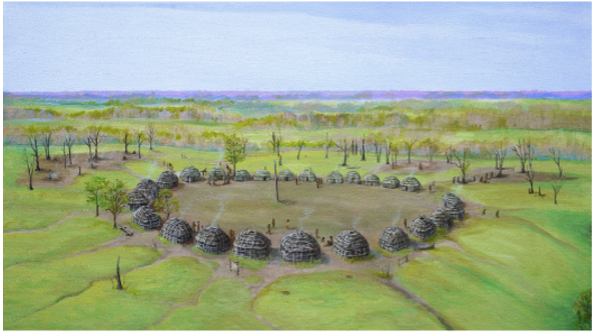
Like Fox Farm, other Middle Ohio River Valley farming villages in the 1200s and 1300s CE consisted of a circular arrangement of houses around a central plaza.
 
Image credit: Fox Farm Site Early Village Circa 1300 AD, painting by Susan A. Walton, S. A. Walton Studio, Hudson, Florida. American Archaeology Magazine, Summer 2016: Volume 20, Number 2, page 22. Used courtesy Kentucky Archaeological Survey

To prepare fields for planting, village farmers set cool, low intensity fires to clear out small trees and brush. They girdledthe larger trees (cut off a wide strip of bark from completely around the trunk) to kill them. This was easier than using groundstone axes to chop them down. Then the people interplanted the Three Sisters – corn, beans, and squash. Once crop production dropped off, they cleared new fields and let the old ones lie fallow (rest) for several years. 

The edges of these agricultural fields, and the human-modified forests beyond them, were perfect habitats for wild turkeys. They were turkey heaven.

In time, usually between 10 to 25 years, Native farmers moved their villages. There were many reasons why. A move ensured more reliable crop production and better supplies of wood for house rebuilding or cooking fires.  A natural disaster, such as a flood or a tornado, might force village residents to move. Internal social or political tensions could also compel residents to move their village. But for whatever reason or reasons, the process of preparing new fields for planting started all over again.

These village farmers were not vegetarians, though. They hunted local wildlife, too, like small mammals, fish, turtles, and freshwater mussels. But the main animals they took were white-tailed deer, elk, bear, and wild turkey. 

Analysis of wild turkey bones recovered archaeologically from these farming villages shows that Native hunters took gobblers and hens in equal numbers. These village farmers were not too concerned about over hunting the local wild turkey population. Since they moved their villages every 10 to 25 years, residents knew the wild turkey flocks would bounce back. 

Hunters Did Things Differently at Fox Farm Village

Around 1300 CE, a group of Native farmers settled on a broad ridgetop in north-central Kentucky. They grew the same crops in fields surrounding their village, and in the same ways as their ancestors had, and like the farmers living in neighboring villages. They also hunted the same animals. By about 1375 CE, however, things were different at Fox Farm. The village population had doubled, houses were larger, and the village plan had changed.  Research shows that people continued to live at Fox Farm – for reasons archaeologists are still trying to figure out – for at least another 200 years.  

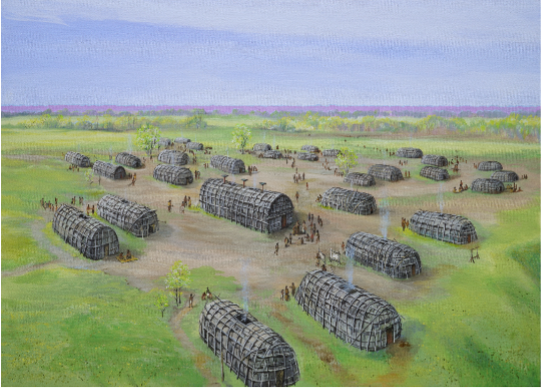
After 1375 CE, long, rectangular, bark-covered houses at the farming village at Fox Farm were oriented parallel to each other and were arranged around a large community building.
 
 
Image credit: Fox Farm Site Longhouses, painting by Susan A. Walton, S. A. Walton Studio, Hudson, Florida. American Archaeology Magazine, Summer 2016: Volume 20, Number 2, page 23. Used courtesy Kentucky Archaeological Survey. 

By staying in one place and having more mouths to feed, village residents were putting more pressure on local natural resources, including the wild turkey flocks. If they continued to hunt wild turkeys in the same way their ancestors had, they would eventually reduce the number of birds. 

So, what did they do?

Analysis of the wild turkey bones from Fox Farm shows that these ancient hunters changed their hunting strategies to ensure they had a reliable meat source for their families. Only one-third of the wild turkey bones came from hens; the other two-thirds came from gobblers. Hunters cut back on bagging hens and focused instead on taking gobblers. Not overhunting hens meant more chicks and sustainable local wild turkey flocks. 

Still Relevant Today 

Today, modern wildlife managers face the same challenges Indigenous hunters faced at Fox Farm around 1375 CE: how to best keep local wild turkey flocks healthy and productive. These ancient bones offer one solution – focus on hunting males to reduce the real risk of over hunting local flocks. The stories they hold reveal a deep time depth to the human management of wild turkeys.


To read more about Fox Farm and the stories animal bones can tell, go here to read about an offering of deer jaws (https://archaeology.ky.gov/Find-a-Site/Pages/Fox-Farm.aspx).

Go here (https://heritage.ky.gov/archaeology/Documents/CARK%20Vol.%2011%20FINAL.pdf) to read about objects made from deer shoulder blades: Artifacts Made from Deer Scapulae Recovered from Fox Farm (15Ms1), Mason County, Kentucky by Bruce L. Manzano, David Pollack, A. Gwynn Henderson, and Thomas W. Royster, pages 2-15. 


Back

More News

Nov 1, 2026

Sid Meier's Civilization® VII: Tecumseh and Shawnee Pack

The Sid Meier’s Civilization VII: Tecumseh and Shawnee Pack is downloadable add-on content that expands the Civilization VII experience with the Tecumseh leader and Shawnee civilization. Please note that the pack is not a standalone game and requires Sid Meier’s Civilization VII, which must be purchased separately. Once purchased, the add-on can be downloaded through […]

Read More
Aug 31, 2026

RECYCLING SPOTLIGHT: BATTERIES

BATTERIES: Why batteries shouldn’t end up in landfills. Key Reasons to Avoid Disposing Batteries in Landfills:

Read More
Aug 14, 2026

PUBLIC COMMENT PERIOD: LOW INCOME HOME ENERGY PROGRAM (LIHEAP)

The Shawnee Tribe is accepting public comments from tribal citizens about the Low Income Home Energy Program (LIHEAP) in preparation for next fiscal year, which begins October 1. All Shawnee households residing in the state of Oklahoma are encouraged to provide comments. Submit comments here through Monday, August 27, 2026. The LIHEAP program also still has funding […]

Read More
Jul 31, 2026

Artist Spotlight: Journey Through Art

The Shawnee Tribe is proud to celebrate the accomplishments of Marina Staubus, whose artwork Whispers in the Wind earned First Place in the Painting category at the 2026 55th Annual Trail of Tears Art Show in Tahlequah, Oklahoma. Marina, a Shawnee Tribe citizen, continues a family tradition of service and dedication to the Tribe as the daughter of Mike Staubus, […]

Read More
Jul 31, 2026

Passing on Tradition: Bow Making Connects Shawnee Youth to Ancestral Knowledge

A traditional bow-making workshop recently brought together Shawnee youth and cultural instructors to share knowledge, skills, and values that have been passed down through generations. The opportunity began when a request was made to teach Shawnee relatives the traditional craft of bow making. Having previously shared these skills with Muscogee participants, the instructors were honored […]

Read More
Jul 31, 2026

WEEMEYAKWE: ANCIENT RITUAL PLACES IN CENTRAL KENTUCKY

By David Pollack, A. Gwynn Henderson, and Edward R. Henry A people’s relationship to their homeland is dynamic. How they alter the landscape reflects their sense of place, their social relationships, and their connections to their ancestors.  This is as true now as it was in the past. The North Elkhorn Creek Earthworks   Around 500 […]

Read More
Jul 31, 2026

♻️ Recycling Spotlight – The Price Tag You Never See

The Hidden Cost of Four Everyday Products When we buy a product, we usually see only the price on the shelf. What we don’t see is the environmental cost of making it. For example, it takes about 2,700 liters (713 gallons) of water to produce a single cotton T-shirt—about the same amount one person drinks […]

Read More
Jun 29, 2026

2026 BUSINESS COUNCIL ELECTION UPDATE

Mark McDowell, Treasurer and Keni Hood, Business Council Seat 7 have filed seeking re-election to their respective offices.  The filing period for candidates has passed, with no additional candidates declaring their intention to run for office.   Therefore, in accordance with Title 6, Sec. 6.20.080 of the Shawnee Election Act, both unopposed candidates are hereby deemed […]

Read More
See All News