Aug 31, 2026
RECYCLING SPOTLIGHT: BATTERIES
BATTERIES: Why batteries shouldn’t end up in landfills. Key Reasons to Avoid Disposing Batteries in Landfills:

WEEMEYAKWE (WHERE WE COME FROM)
By A. Gwynn Henderson and David Pollack
“Two heads are better than one,” the old saying goes. With twice the brainpower and two times the life experiences to draw from, we are twice as likely to solve a puzzle, make sense of an enigma, or figure out a mystery.
The decades-long mystery in this case? The identity of five, marble-sized, black stone spheres discovered during excavations at the 89-acre Seip Earthworks Complex. This complex is an important Hopewell Culture (circa 1 to 400 CE) ceremonial site located next to Paint Creek in Ross County, Ohio.
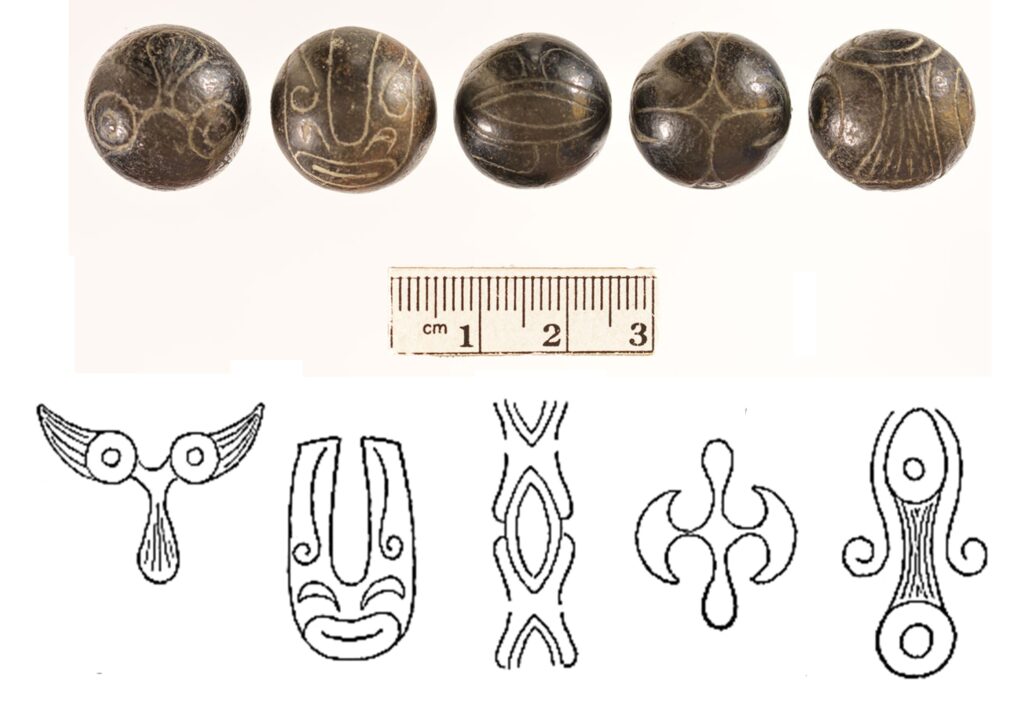
Spheres (top) and the engraved designs (bottom). Spheres photograph used courtesy of the Ohio History Connection. Line drawing of engraved designs by HRG in H.C. Shetrone and E. Greenman, Ohio State Archaeological and Historical Quarterly, volume 40, figure 45, page 426, 1931.
And the two heads? One belongs to a Shawnee man steeped in Shawnee traditions: Chief Ben Barnes of The Shawnee Tribe. The other belongs to Dr. Brad Lepper, an archaeologist steeped in Ohio Valley archaeology who works for the Ohio History Connection.
The Discovery
In 1926, the Ohio Archaeological and Historical Society investigated the loaf-shaped Seip-Pricer Mound, one element of the Seip Earthworks Complex. This mound, one of the largest Ohio earthen mounds, stands near the center of the complex’s large circular enclosure.
At the base of the mound, investigators found a massive, clay-lined oval basin. It measured 30 feet long by 10 feet wide and was nine inches deep. Intense heat had turned the clay lining the color and hardness of soft brick.
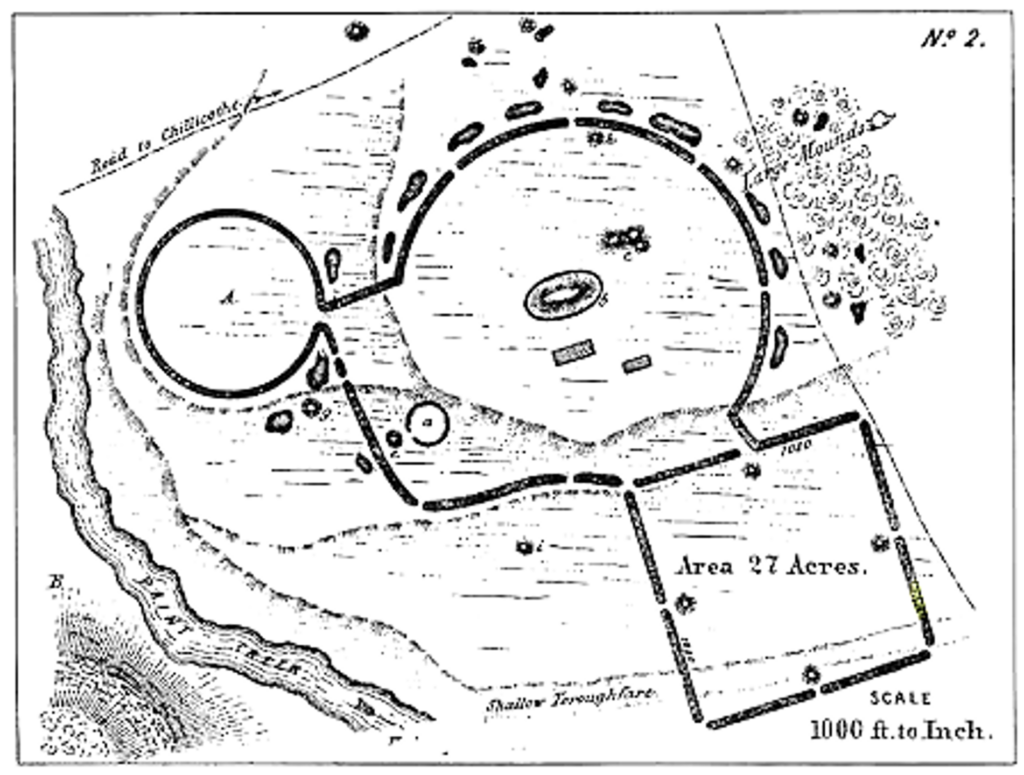
Map of the Seip Earthworks by Ephraim Squire and Edwin Davis in Ancient Monuments of the Mississippi Valley, Plate 21, Number 2, 1848. VIEW this image at the National Park Service.
This basin was not filled with everyday trash. It held over 5,000 objects of “exceptional artistry.” Thousands of shell beads. Copper breastplates. Bear and mountain lion canine teeth. Alligator and shark teeth. Chipped stone tools. Fragments of ceramic vessels. Fragments of a large wooden bowl or plate. Charred fabric and leather fragments.
These materials likely represent ritual regalia used during a major ceremony. At the end of the ceremony, religious leaders placed these items in the clay-lined basin. And then, they set them on fire. This event likely took place around 300 CE.
The Spheres
According to H. C. Shetrone, the archaeologist who directed the site investigations, the most interesting objects recovered from the basin were five engraved black steatite spheres. These spheres are very nearly the same size: about two inches in diameter, only slightly larger than the official size of today’s shooter marble. They weigh around 0.4 ounces each.
Steatite, or soapstone, is a soft, carveable rock made mainly of talc. Indigenous artists were no strangers to this material, for they carved other items, like stone bowls and smoking pipes, out of it. It would have taken serious skill to carve the raw stone in such a way as to be sure that the spheres were the same size. Engraving each with a unique design also took skill. A craftsperson likely used a sharp pointed object harder than the stone – perhaps a chipped stone drill – to do this.
Steatite outcrops along the eastern edge of the Appalachian Mountains, from northern New England south to eastern Alabama. Local artists would have either traded for the stone or traveled to the ancient steatite quarries to get it. It is also possible that outsiders brought the finished stones to the site as offerings.
Previous Interpretations
In the years since their discovery, archaeologists have offered two different interpretations for these enigmatic stone spheres. The first is that they were marbles or gaming pieces. They certainly do look like marbles, but Native peoples did not play that game in ancient times. Traditional Native gaming pieces are not round, they are two-sided.
The second is that religious leaders used the spheres in divination activities (in other words, to predict the future). But traditional divination objects are usually single pebbles, not sets of carefully rounded marble-sized stones.
A Native-Informed Interpretation
Here is where two heads, informed by a Native perspective, come together to offer a third, and entirely different, interpretation. Perhaps the five black steatite spheres from the Seip-Pricer Mound are the non-perishable parts of a water drum!
Spherical black stones measuring .79 inches in diameter are a common component of Shawnee water drums. An odd number of these stones is needed to securely tie a water-soaked, brain-tanned leather hide (the drumhead) to the drum shell (body) with cordage.
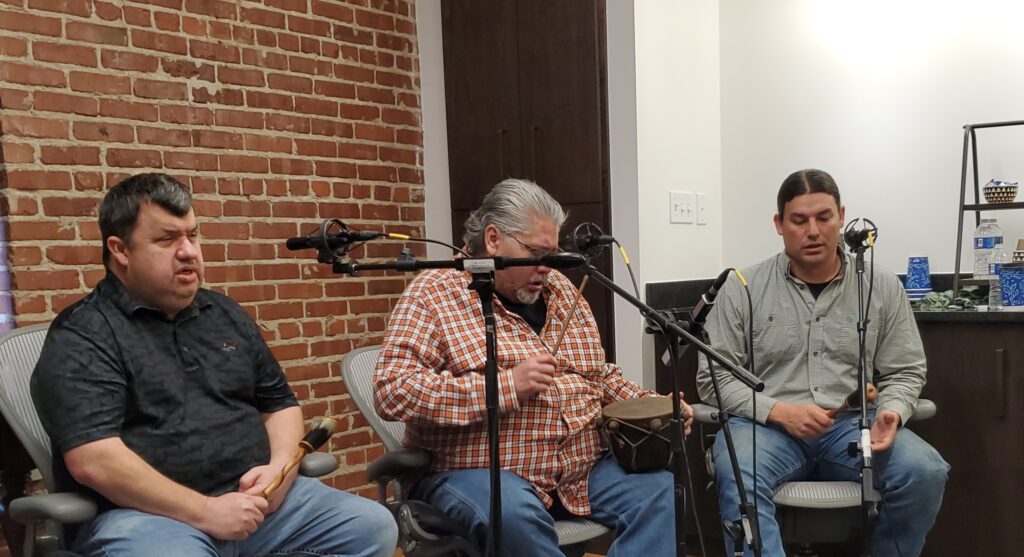
(Pictured left to right) Joel Barnes (Director of Shawnee Language Immersion Program), Brett Barnes (Eastern Shawnee) and Trenton Stand (Shawnee), record a song, using a water drum, in the Shawnee Tribe conference room. Shawnee Tribe 2024.
Does This New Interpretation Make Sense?
Archaeologists are fairly certain that the Ohio Valley’s Indigenous peoples used drums, and that they likely used them during ceremonies. But archaeologists have rarely identified ancient Native drums.
One reason is that, once disassembled into its parts, a drum is not easy to recognize in the archaeological record. For example, at the Seip-Pricer Mound, fragments of a wooden bowl recovered from the clay-lined basin might have been the shell of a water drum. But in the fire, the drum would have fallen apart as the drum shell, the leather drumhead, and the cordage fastening burned. In this way, the stones would have separated from the drum. The same would be true had the drum been a ceramic vessel that was broken when placed in the clay-lined basin. Thus, after centuries, all that was left of the drum were the stones and perhaps fragments of a wooden or ceramic vessel.
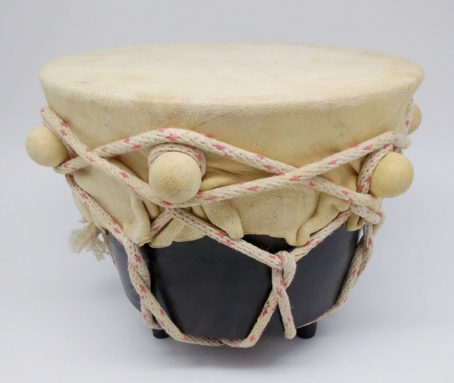
A footed Shawnee water drum assembled by Chief Ben Barnes. Notice how the cordage wraps around, above, and below each spherical drum stone placed a few inches below the lip of the drum shell. This creates a circular bulge beneath portions of the leather drumhead that extend down the sides of the drum shell. Photograph courtesy of the Ohio History Connection.
Another reason archaeologists rarely identify ancient drums is because most of a water drum is made from perishable materials: wood, leather, and cordage. Thus, after centuries in most instances, all would have decayed away except the stones.
Barnes and Lepper’s interpretation is important. If they are right, the five engraved spheres from the Seip-Pricer Mound are the earliest direct evidence for a drum in eastern North America. This new interpretation also suggests that there is cultural continuity between those who built the mound and tribal peoples of today. Researchers need to re-examine existing site collections to look for small, spherical stones that may once have been part of a water drum.
Two heads are, indeed, better than one. And in this case, they have offered us new insights into the past.
READ Barnes and Lepper’s article about their interpretation of the five spheres.
ABOUT THE AUTHORS
A. Gwynn Henderson (Education Director) and David Pollack (Director) work for the Kentucky Archaeological Survey, Department of Society, Culture, Crime & Justice Studies at Western Kentucky University. They received their PhDs in Anthropology from the University of Kentucky in 1998. Their involvement in Fort Ancient/ Shawnee archaeological research began in the early 1980s, when they analyzed and reported on archaeological materials recovered from the lower Shawnee Town. One of their ongoing research projects focuses on the lifeways of ancient Native farming cultures of the middle Ohio Valley.

BATTERIES: Why batteries shouldn’t end up in landfills. Key Reasons to Avoid Disposing Batteries in Landfills:
The Shawnee Tribe is accepting public comments from tribal citizens about the Low Income Home Energy Program (LIHEAP) in preparation for next fiscal year, which begins October 1. All Shawnee households residing in the state of Oklahoma are encouraged to provide comments. Submit comments here through Monday, August 27, 2026. The LIHEAP program also still has funding […]
The Shawnee Tribe is proud to celebrate the accomplishments of Marina Staubus, whose artwork Whispers in the Wind earned First Place in the Painting category at the 2026 55th Annual Trail of Tears Art Show in Tahlequah, Oklahoma. Marina, a Shawnee Tribe citizen, continues a family tradition of service and dedication to the Tribe as the daughter of Mike Staubus, […]
A traditional bow-making workshop recently brought together Shawnee youth and cultural instructors to share knowledge, skills, and values that have been passed down through generations. The opportunity began when a request was made to teach Shawnee relatives the traditional craft of bow making. Having previously shared these skills with Muscogee participants, the instructors were honored […]
By David Pollack, A. Gwynn Henderson, and Edward R. Henry A people’s relationship to their homeland is dynamic. How they alter the landscape reflects their sense of place, their social relationships, and their connections to their ancestors. This is as true now as it was in the past. The North Elkhorn Creek Earthworks Around 500 […]
The Hidden Cost of Four Everyday Products When we buy a product, we usually see only the price on the shelf. What we don’t see is the environmental cost of making it. For example, it takes about 2,700 liters (713 gallons) of water to produce a single cotton T-shirt—about the same amount one person drinks […]
Mark McDowell, Treasurer and Keni Hood, Business Council Seat 7 have filed seeking re-election to their respective offices. The filing period for candidates has passed, with no additional candidates declaring their intention to run for office. Therefore, in accordance with Title 6, Sec. 6.20.080 of the Shawnee Election Act, both unopposed candidates are hereby deemed […]
YOUR CAN COULD BE BACK ON THE SHELF IN JUST 60 DAYS! You enjoy your beverage and recycle your aluminum can. Recycling trucks collect the cans and take them to a facility to be sorted. The cans are cleaned and shredded into small pieces. The aluminum pieces are melted down and rolled into large sheets. […]