
WEEMEYAKWE: COMING HOME — CATAHECASSA’S 1816 VISIT TO EASTERN CLARK COUNTY, KENTUCKY

By A. Gwynn Henderson and David Pollack

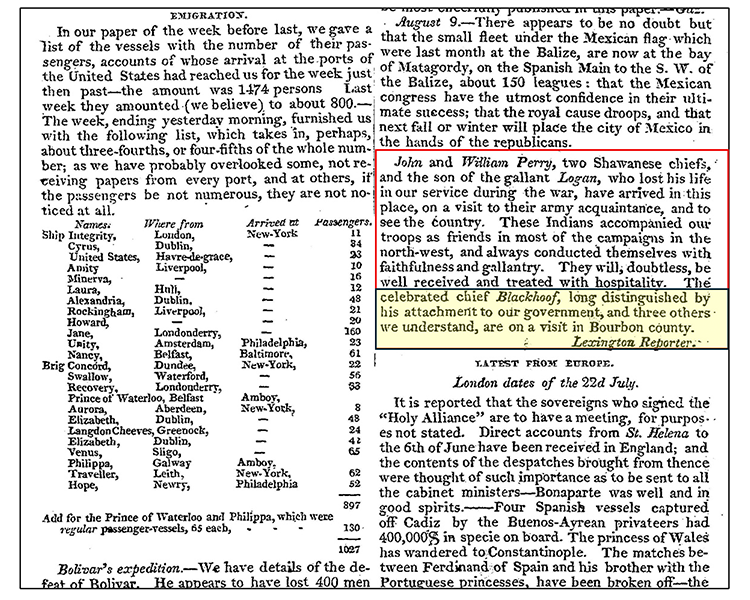
On September 7, 1816, readers skimming the Niles’ Weekly Register might have noticed a story about two groups of Shawnee men visiting central Kentucky. It appears on a page with a variety of national and international news: an accounting of how many immigrants had arrived in America, details of Simón. Bolivar’s defeat, and a summary of European social and political events.

Copy of a section of a page from “Niles’ Weekly Register” for September 7, 1816. The article about the Shawnee men’s visits is outlined in red; mention of Catahecassa’s visit is highlighted in yellow. “Niles’ Weekly Register”, edited and published by Hezekiah Niles until 1836, was one of the most influential papers in the United States. Image provided by Stephen Warren.

Subscribers who stopped to read the story in full would have learned that the first group had come to Lexington, Kentucky to visit their former army buddy. What brought the second group to Bourbon County, located northeast of Lexington, was not mentioned. The important person in that group, however, was named: Catahecassa (also called Black Hoof), principal civil chief of the Shawnee.

In his mid-70s in 1816, Catahecassa was no stranger to travel. In his youth, he had taken part in conflicts scattered across the Ohio Valley and upper Midwest. In his later years, as a diplomat, he had traveled to Washington D.C. to advocate for the Shawnee people. At the time of this trip, he was still active in Shawnee political affairs.

Unlike those 1816 readers, however, we do know one reason – perhaps the main reason? – why Catahecassa and his companions came to central Kentucky: to visit the area near Goffs Corner in eastern Clark County.

How do we know this?

Interviews carried out by Rev. John D. Shane of Cincinnati in the 1840s and 1850s with Kentucky’s aging early settlers. Shane had interviewed Clark County residents about the history of the Goffs Corner area. And those who had met the great Shawnee leader, orator, and diplomat and his companions in 1816 shared their experiences with Shane.

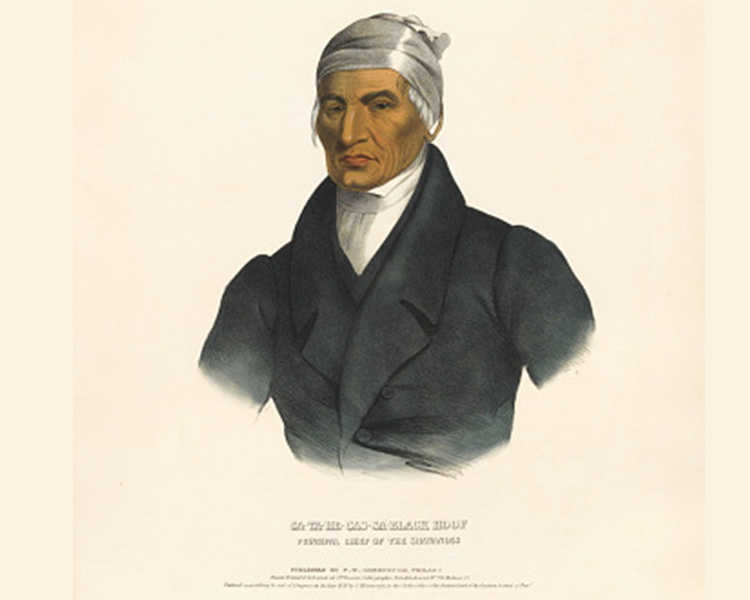
Portrait of Catahecassa (Black Hoof), 1838. Print by J. T. Bowen Lithography Company after a painting by Charles Bird King. National Portrait Gallery, Smithsonian Institution. Catahecassa believed that peace and blending in with Whites was the only way for the Shawnee Nation to keep their remaining lands and communities together. Charles Bird King would have painted his famous subject sometime between 1821 and 1831, while Catahecassa was on a diplomatic visit to Washington D.C. This portrait of  Catahecassa survives only as a lithograph, since the original was lost in a fire. 

Why the Goffs Corner Area?

Eastern Clark County near Goffs Corner is a beautiful, even magical, rural place today. Bounded by Upper Howard’s Creek on the west and Lulbegrud Creek on the east, it is the last real level spot travelers cross before they enter Kentucky’s Eastern Mountains.

In 1816, it was a rural place, too. Widely scattered farmhouses, agricultural fields, and woodlands. Fresh and saltwater springs and salt licks. Good soil for crops. Diverse resources available to anyone living in this boundary zone of the Kentucky Bluegrass and the mountains. But there is no seat of government to visit, no powerful men to persuade.

Why, then, visit? What made this place so special to Catahecassa?

Memories. Memories of home.

The Trip

The travelers likely had started south from Wapakoneta in northwestern Ohio, where Catahecassa lived at the time. By modern calculations, the men would have covered a distance of about 220 miles on their way to their destination. If they had cut across country, the route might have been shorter. Travel in the early 1800s would not have been particularly easy. “Roads” were dusty tracks or muddy traces that extended from settlement to settlement, and true roads would not appear for decades.

The Visit

In their remembrances, the Clark County residents describe Catahecassa as an elderly man who said he had made the trip to “keep this place in mind” and to show it to his young companions.

Local resident Jesse Daniels remembered breakfasting with the travelers. Catahecassa, known for his oratory skills, delivered a speech, translated by one of his Kentucky hosts who was traveling with the group. Daniels recalled that in this speech, Catahecassa recounted the history of the area. He mentioned the Shawnee settlement where he had lived in 1754, and commented that hostilities with a southern tribe had forced his community to move away.

One Link in a Long Chain of Indigenous History 

Catahecassa’s 1816 visit could be considered a kind of pilgrimage to his old home. If he truly was born around 1740, then he would have been around 14 years old when he and his family lived there.

But there is more to this story than one Shawnee man’s return to the home of his youth. His is one link in a long chain of Native stories – thousands of individual stories – that reaches back over 10,000 years. These stories are written on the landscape. Remnants of scores of ancient seasonal camps. A circular farming village that more than 200 people may have called home for four decades over 700 years ago.

But there is more.

This area is also an ancient spiritual place. Native peoples built earthen burial mounds and circular enclosures on the ridgetops more than 2,000 years ago. Some enclosures are clearly visible today. Their causeways are aligned to the summer solstice sunrise and to the major moonrise, when the moon appears to pause in the Northern sky.

These ancient monuments remained sacred places even after their builders no longer visited them. Large, tall, rock-chinked, commemorative wooden marker poles were erected near some enclosures.

Archaeological research shows that later Indigenous peoples visited, revered, and often took care of these ancient monuments for over 2,000 years. These circular enclosures would have been known to, and likely even visited by, the young Catahecassa and his family.

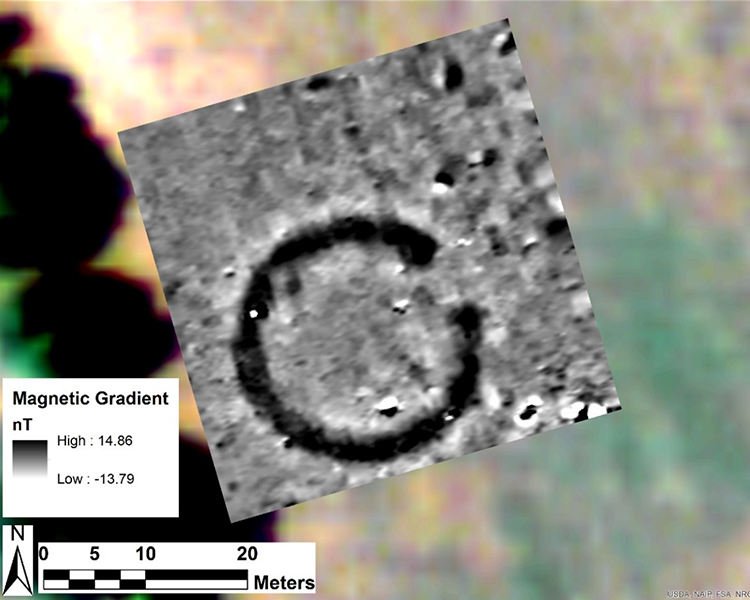
A  subsurface map of the Earthwalker circular enclosure. Notice the enclosure’s entrance. Archaeologists made this map during a magnetometer survey of the site – a geophysical technique using magnetic field strength and direction to record features below ground. Image used with permission, Edward R. Henry.

Taking Meaning for Us Today

Home is not only where we live now; it is also the place our hearts consider home. Catahecassa’s visit illustrates how strong the pull of memories can be.

Neither the readers of Niles’ Weekly Register nor us today can know for certain what called to Catahecassa from across the miles and through the years. But it was a strong call, significant enough for him to make that journey home.

His visit reminds us to hold these places in our hearts and preserve and protect them. They make us who we are, and we cannot be whole without them.


To learn more about a circular enclosure near Goffs Corner, Kentucky read the Earthwalker site profile on Discover Kentucky Archaeology.

To appreciate Catahacassa’s oratory talent, read the February 5, 1802 speech he delivered to President Thomas Jefferson on behalf of himself and the Delaware and Shawnee Nations.

ABOUT THE AUTHORS

A. Gwynn Henderson (Education Director) and David Pollack (Director) work for the Kentucky Archaeological Survey, Department of Society, Culture, Crime & Justice Studies at Western Kentucky University. They received their PhDs in Anthropology from the University of Kentucky in 1998. Their involvement in Fort Ancient/ Shawnee archaeological research began in the early 1980s, when they analyzed and reported on archaeological materials recovered from the lower Shawnee Town. One of their ongoing research projects focuses on the lifeways of ancient Native farming cultures of the middle Ohio Valley.


Back

More News

Mar 5, 2026

CELEBRATING AMERICA RECYCLES DAY AT THE MUSCOGEE (CREEK) NATION RECYCLING EVENT!

On November 15, Shawnee Tribe’s Environmental Manager, Cindy Riley, participated in the Muscogee (Creek) Nation’s recycling event to explore new ways of collecting and processing materials—from electronics and batteries to tires, and many more items—and to bring those best practices back to our own tribal community. Key takeaways: Next steps: Together, we can grow our […]

Read More
Mar 4, 2026

RECYCLING SPOTLIGHT: TINY BUT TOXIC - BUTTON BATTERIES

Button cell batteries are the small, flat, round batteries found in watches, hearing aids, key fobs, calculators, toys, and medical devices. They may be tiny, but they contain valuable materials and can create safety hazards if thrown in the trash. Because they are so small, button batteries are often tossed with household waste. However, lithium […]

Read More
Mar 2, 2026

WRAP UP: TEMPORARY EMERGENCY FOOD BENEFIT ASSISTANCE

On October 22, 2025, the Shawnee Tribe was notified that the Supplemental Nutrition Assistance Program (SNAP) would pause operations during the month of November due to a protracted government shutdown. In response, the Shawnee Tribe developed the Temporary Emergency Food Benefit Assistance Program, which was established by October 29, 2025, to support Shawnee Tribe families […]

Read More
Feb 26, 2026

CITIZEN SPOTLIGHT: MAG WALLS 105TH BIRTHDAY CELEBRATION!

Meet Magdalene “Mag” Walls, a proud Shawnee citizen born on February 25, 1921, in Ramona, Oklahoma. Her early years were spent in Ramona before her family moved to White Oak, where Mag attended grade school and met her first husband. Together, they had two wonderful children, Deloris and Jim. In 1942, Mag embarked on a […]

Read More
Feb 24, 2026

CHIEF RON SPARKMAN SHAWNEE TRIBE COUNCIL CHAMBERS

On Monday December 8, the new Chief Ron Sparkman Shawnee Tribe Council Chambers, located at 29 S. Main Street, held its naming, dedication and ribbon-cutting ceremony. The newly designed interiors included the main tribal chambers, private tribal chambers, kitchen and prep space, restrooms, and a private meeting space all adorned with modern flooring, walls, lighting, […]

Read More
Feb 23, 2026

CALL FOR PROJECTS: 2026 SHAWNEE LANGUAGE FAIR

Shawnee language learners of all ages and abilities are invited to join the Shawnee Language Immersion Program for the 2026 Language Fair, Dinner and Stomp Dance on Saturday, July 25 in Miami, OK. Citizens of all three Shawnee nations are eligible to participate. Over $6,000 in prizes will be awarded to the top three winners […]

Read More
Feb 5, 2026

RECYCLING SPOTLIGHT: HOW TO RECYCLE CLOTHING & ACCESSORIES

Did you know that the average US Citizen throws away an average of 70 lbs. of clothing annually? The fashion industry is a major contributor to global pollution, generating about 10% of annual CO₂ emissions. Reusing, donating, or recycling clothing helps reduce its environmental impact. Clean Out Your Closet—Responsibly Finished cleaning out your closet and […]

Read More
Feb 5, 2026

STAFF SPOTLIGHT: JENEAN PERRYMAN

Hello! My name is Jenean Perryman, and I’m so grateful to join the Shawnee Tribe as the Education Outreach and Special Projects Director. I’m honored to be part of this community and appreciate the opportunity to work alongside tribal youth, families, and our education partners. I am a citizen of the Choctaw Nation – Halito […]

Read More
See All News